| Description
|
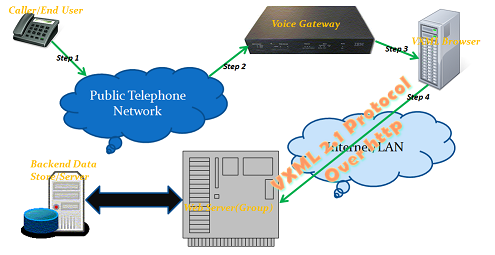
- An end user calls the service number from an endpoint on the public switched telephone network.
- The voice gateway receives the call and passes on to a VXML browser.
- VXML browser hits the proper VXML server based on the number that is dialed, through the Internet or a Local Area Network (LAN) using VXML protocol over http.
- VXML server consults the data back-end for business logic and issues proper instructions to VXML browser on how to respond to the caller. For example, to play a prompt, to collect a key input or voice response, to transfer to a destination etc.
- The caller interacts with the system with a dialog from this point on.
|
|
| How does Voice XML work?
|
Comparision Table
| Voice XML Solution |
Conventional IVR Solution |
| Industry standard protocol, customers are free to move from vendor to vendor |
Proprietary protocol, customers can only switch easily if the new vendor happens to have the same IVR platform as the existing one. |
| Voice portal and backend system are separate. Customers are free to run their own backend system to control call flow in real-time. |
Voice portal and backend system are together. Customers access historical call data via web portal or data integration service provided by vendor. |
| Data security can be exclusively controlled by customer's backend. |
Data security is addressed by both vendor and customer. |
| Call features are only supported within the framework of VXML spec. |
Call features can be extended in anyway using proprietary protocols. |
|
|